Portrait of Zaha Hadid by © David Levene, screen-printed on the glass of The Opus © photo Giusy Ba
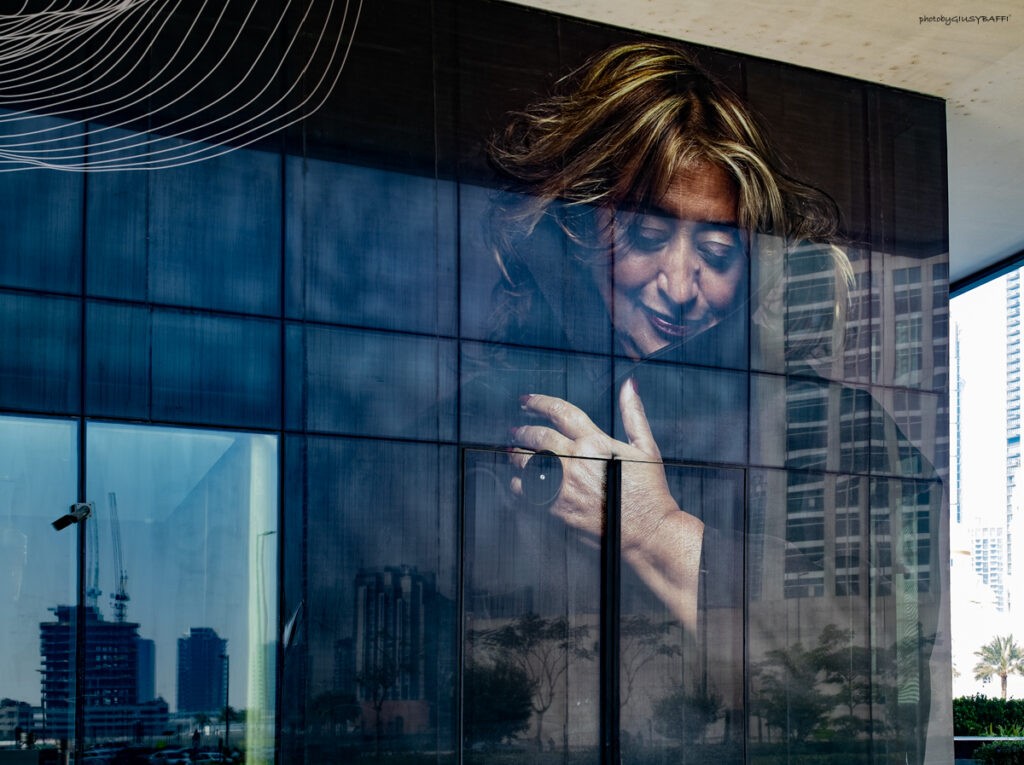
Zaha Hadid is undeniably recognized by the historian Prestinenza Puglisi as one of the three architectural geniuses of the 1990s, alongside Rem Koolhaas and Frank O. Gehry, achieving a design that is both experimental and sophisticated, becoming one of the pioneers of a design approach that fully exploits the infinite possibilities of parametric geometry. (Source: https://giusybaffi.com/decostruttivismo-architettura-spazio-in-evoluzione/)
In the heart of Dubai, halfway between the Burj Khalifa, the tower that holds the record as the world’s tallest building at 828 meters in height, and the new Dubai Water Canal, another landmark for the city was inaugurated in 2020: Zaha Hadid’s The Opus, a mirrored glass building housing a hotel, offices, serviced apartments, and several restaurants.
The building was designed entirely by Zaha Hadid, both in terms of its architecture and the design of every interior detail. The initial project dates back to 2007, and construction began in 2012.
With a surface area of almost 84,000 square meters and a total height of 93 meters, The OPUS is conceived as two separate towers that merge into a single entity, taking the form of a cube. It has the unique feature of assuming a different identity depending on the viewpoint, displaying two facades that tell two distinct construction stories.
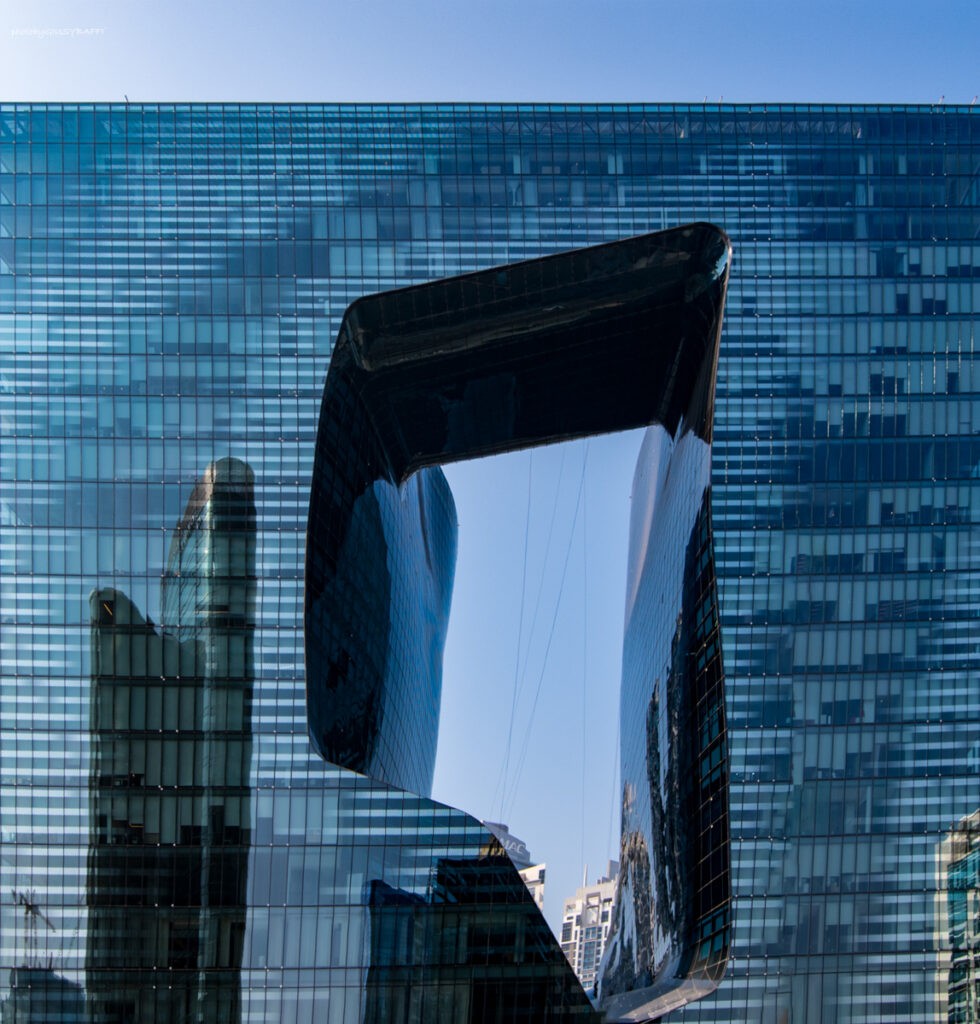
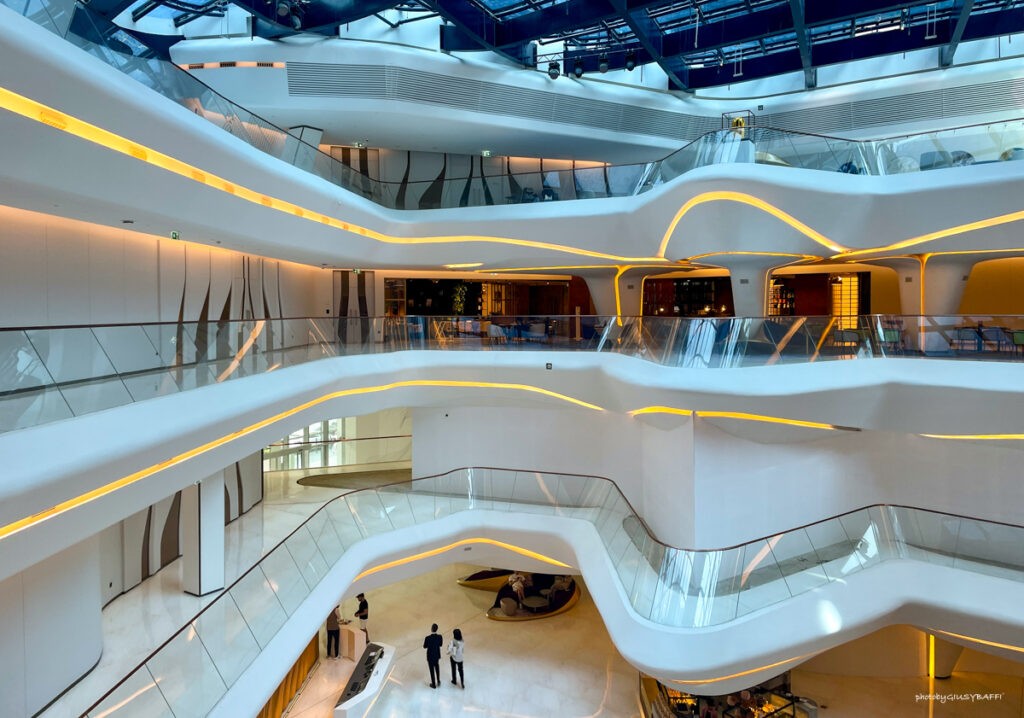
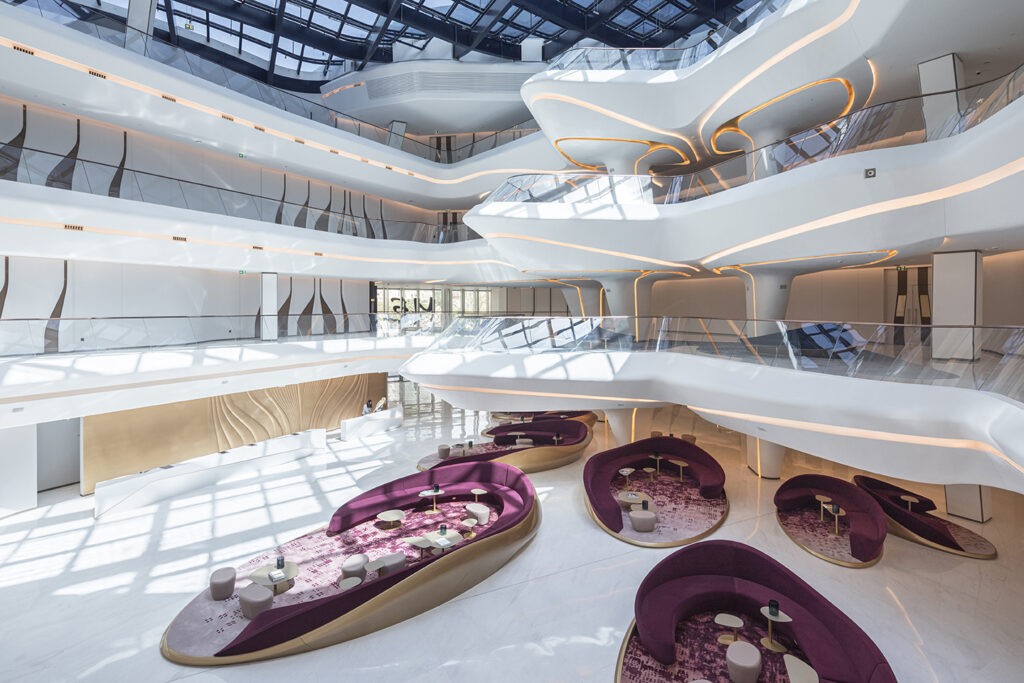
At the center of the cube, almost sculpted, a free-form void has been designed, soaring eight floors high, bordered by fluid surfaces, in contrast to the precise orthogonal geometry of the surrounding cube.
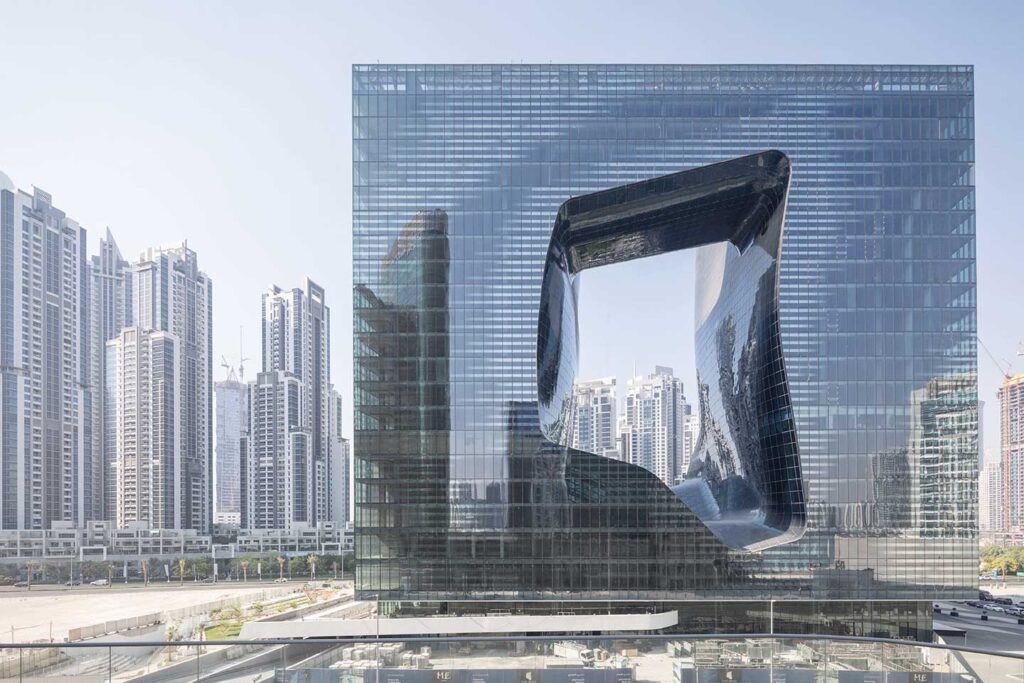
The facade of the void space is a surface of 6,000 square meters designed through 3D digital modeling and has been constructed using 4,300 flat glass elements, with single or double curvature.
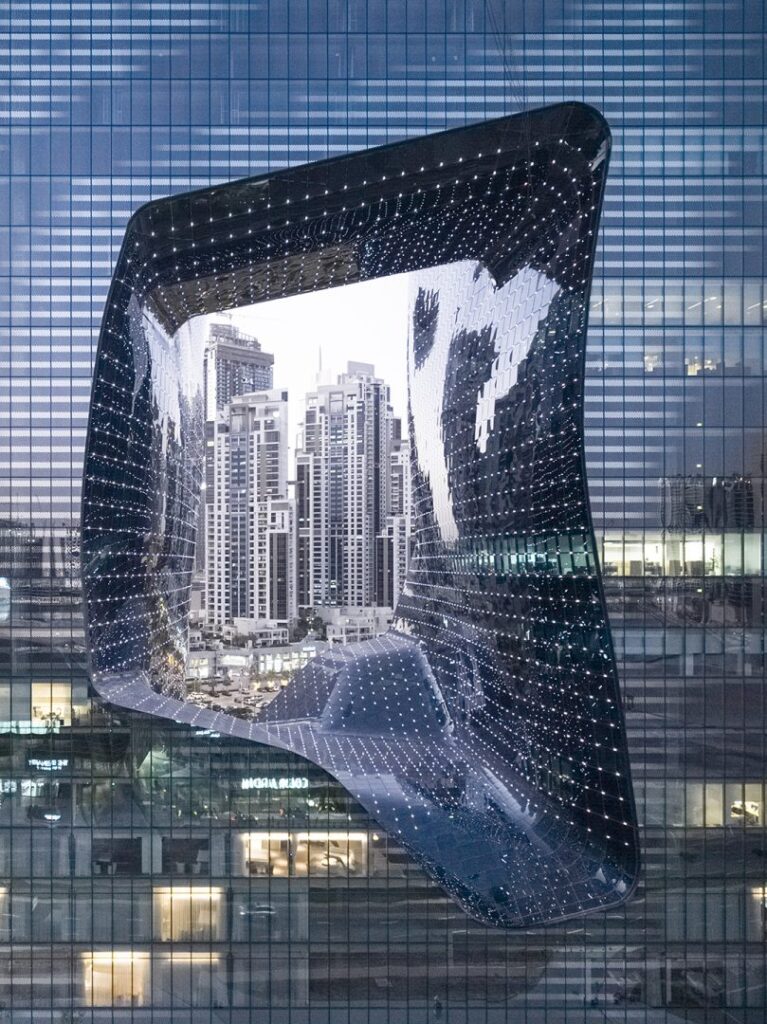
The two towers share a common base and only partially converge in the upper levels through an asymmetrical steel bridge, three floors high and located 71 meters above the ground.
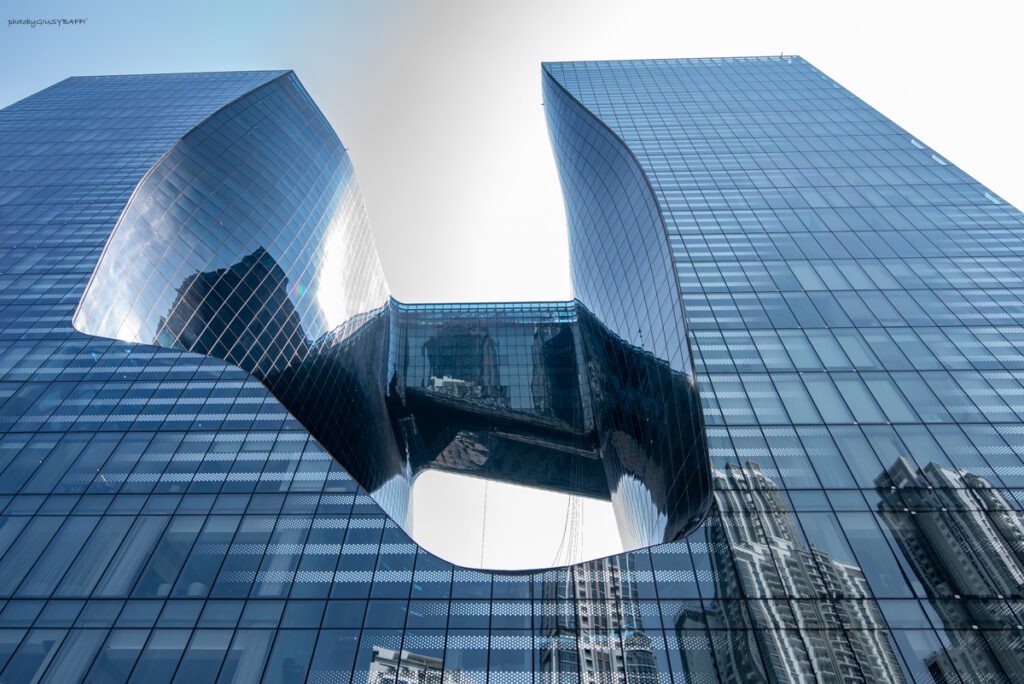
It is precisely the tension between the strictly rectangular outer façade and the organic effect of the internal cavity that bestows the building with its unique character.
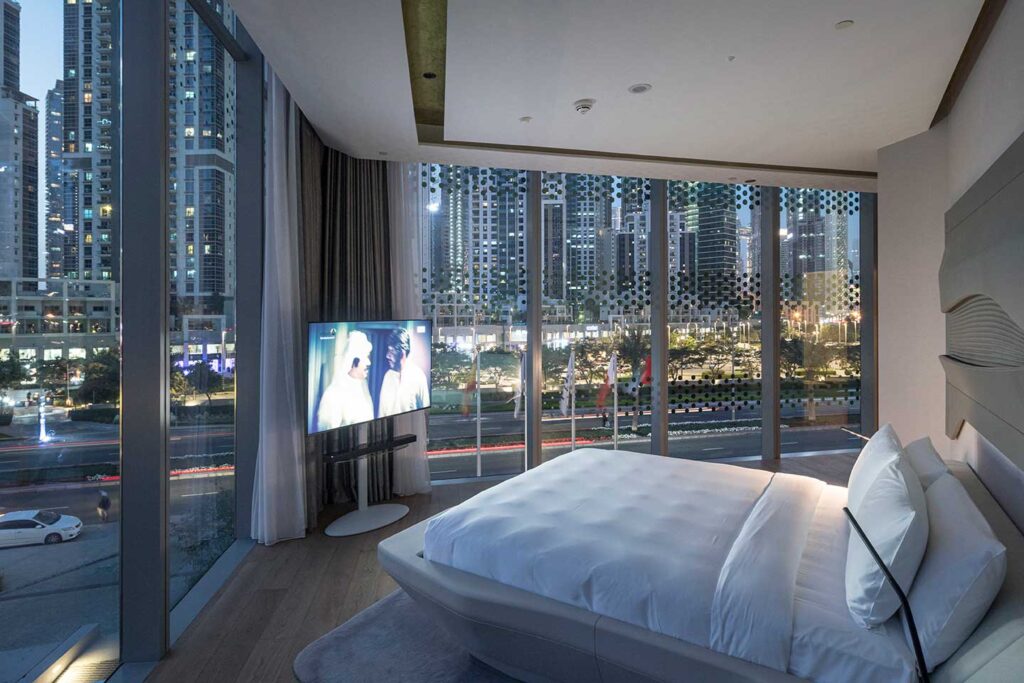
The exterior façades are constructed with transparent, insulated glazing featuring a mirrored pattern and a double-skin glass system. They incorporate a UV-protective coating and a pattern that shields the interior spaces from excessive solar radiation, while the outer surface is animated by dotted and mirrored sun-shading screens.
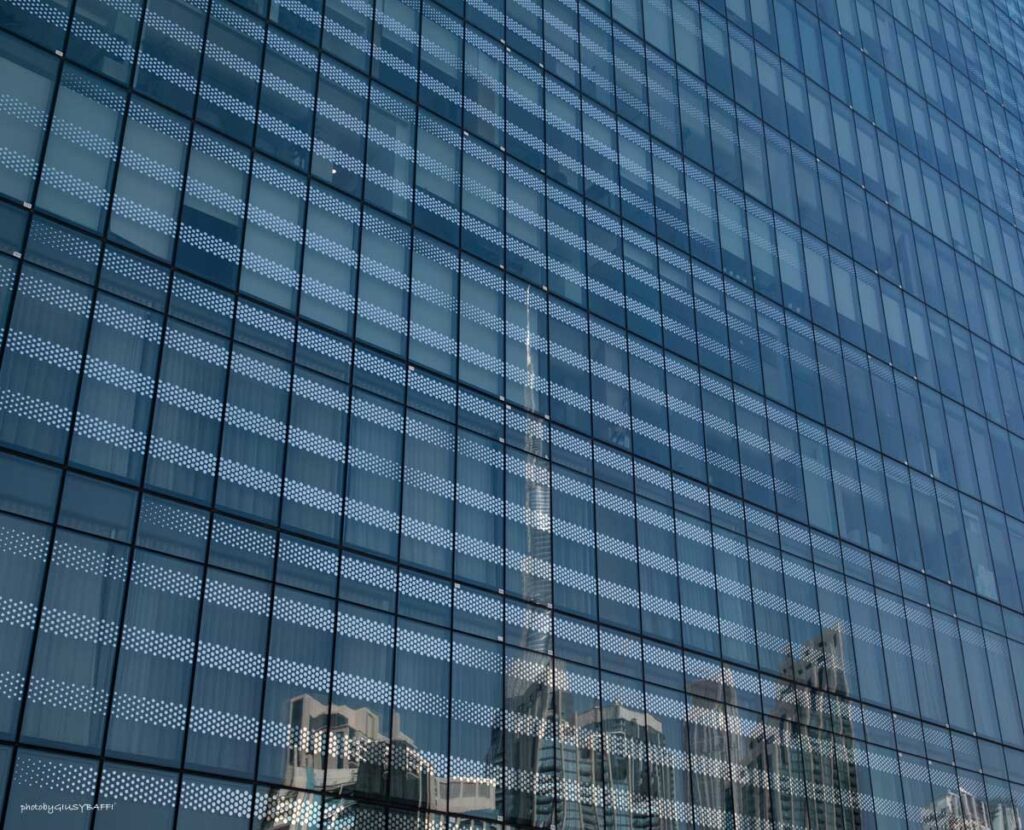
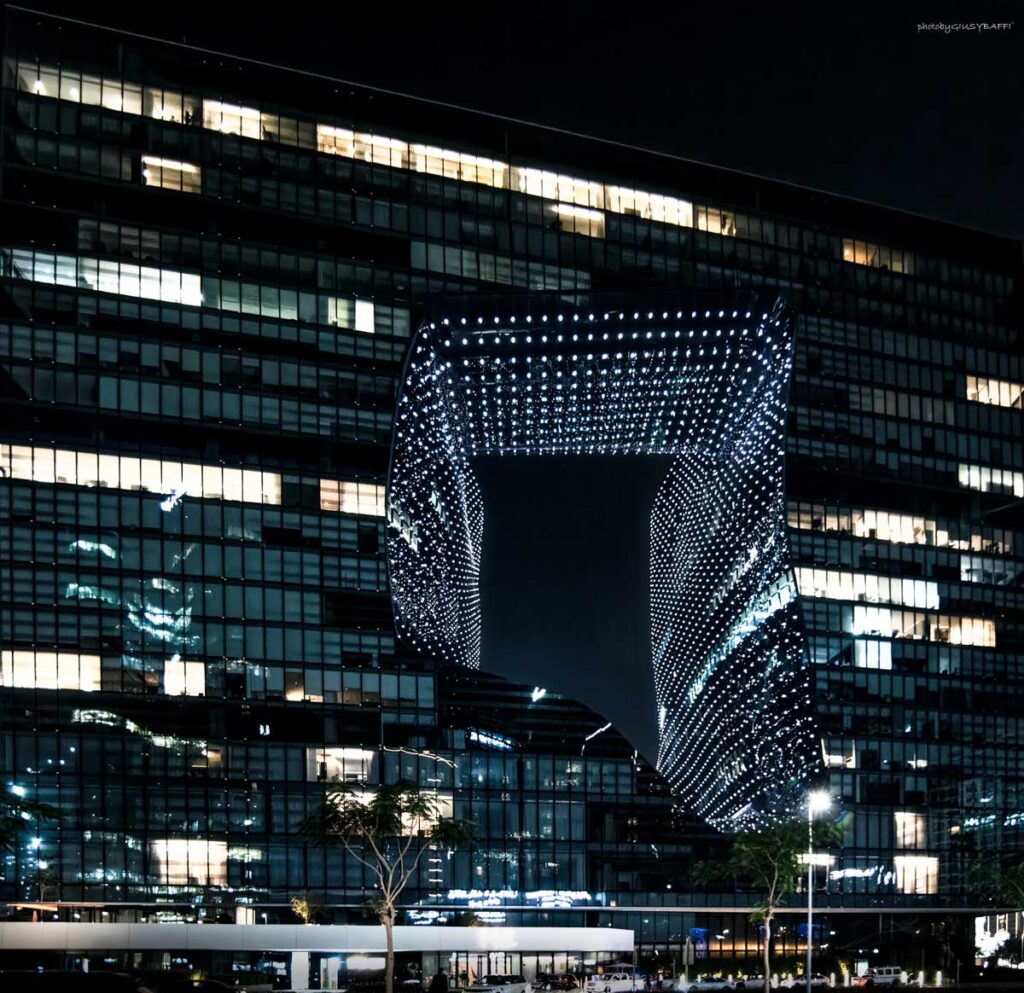
This pattern applied around the building emphasizes the orthogonal shape of the cube while simultaneously lightening its volume through a continuous interplay of light, combining reflections and transparencies. This contrasts with the free-form void inside, featuring dark blue glass panels that illuminate at night with LED lights. Due to its unique ability to reflect daylight and the distinctive nighttime LED illumination, the structure has earned the moniker of the “building that never sleeps.”
The ventilation and lighting of the interior spaces are automatically controlled by sensors, allowing for the reduction of energy wastage.
The interior of The OPUS houses the new ME Dubai, a five-star hotel by the Spanish chain Melia Hotels International, featuring 74 rooms and 19 suites. Additionally, there are 12 restaurants, 5,200 square meters of office space, cafes, rooftop bars, as well as the renowned Japanese robatayaki restaurant Roka and The Maine Land Brasserie.
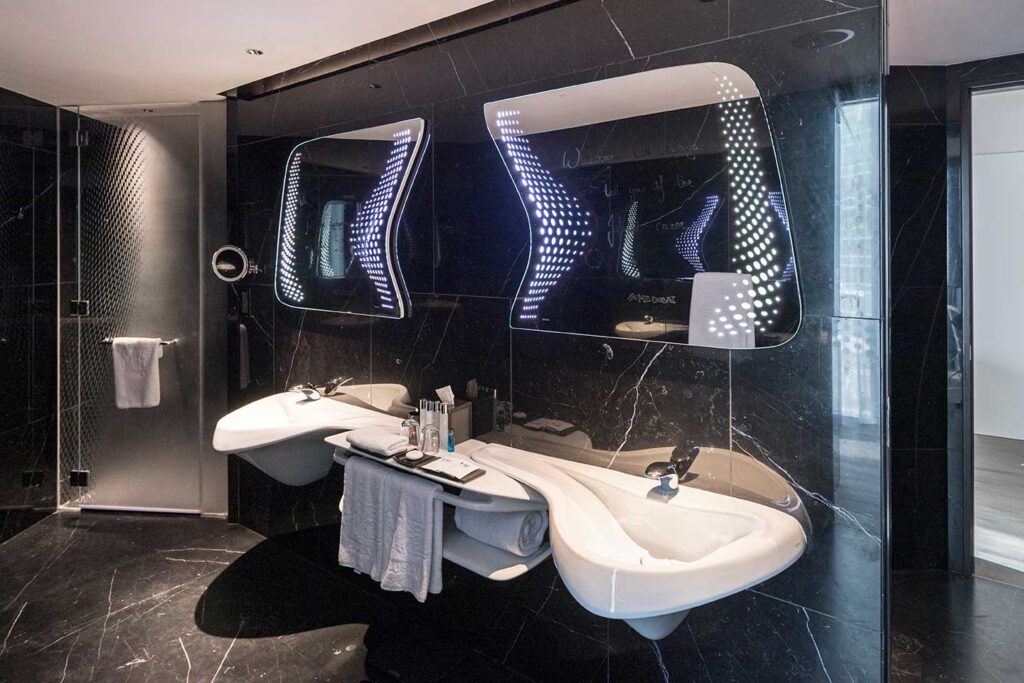
For the interiors of the ME Dubai hotel, furniture designed by Zaha Hadid Design has been utilized, including sofas and seating in the atrium, beds, and furnishings in the suites. These designs interpret and continue the exploration of fluid lines that characterize Zaha Hadid’s architecture as a whole.
The new hotel is therefore the only one in the world that can boast the signature of the Anglo-Iraqi architect, who passed away in 2016, both for the architectural project and for the interior design.
Currently, Zaha Hadid’s constructions are scattered all over the world, spanning rivers, roads, and squares, or stretching along the slopes of Russian plateaus or atop mountains. Seemingly weightless despite their significant dimensions, they appear to float in the air, adopting the shapes of the wind, the sea, eroded land, and desert dunes.
source: Archdaily – Floornature – Zaha Hadid Architects
©Giusy Baffi 2023
©The photos have been sourced from the internet and may be subject to copyright. The use of the images is solely for explanatory purposes. The intention of this blog is purely educational and informative. If the publication of the images were to infringe upon any copyright, please notify us via email at info@giusybaffi.com, and they will be promptly removed or the copyright will be cited as ©.
© The current website https://giusybaffi.com/ is not for profit, and any exploitation, reproduction, duplication, copying, or distribution of the Site’s Content for commercial purposes is prohibited.